How to Verify Vehicle Odometer Readings Safely
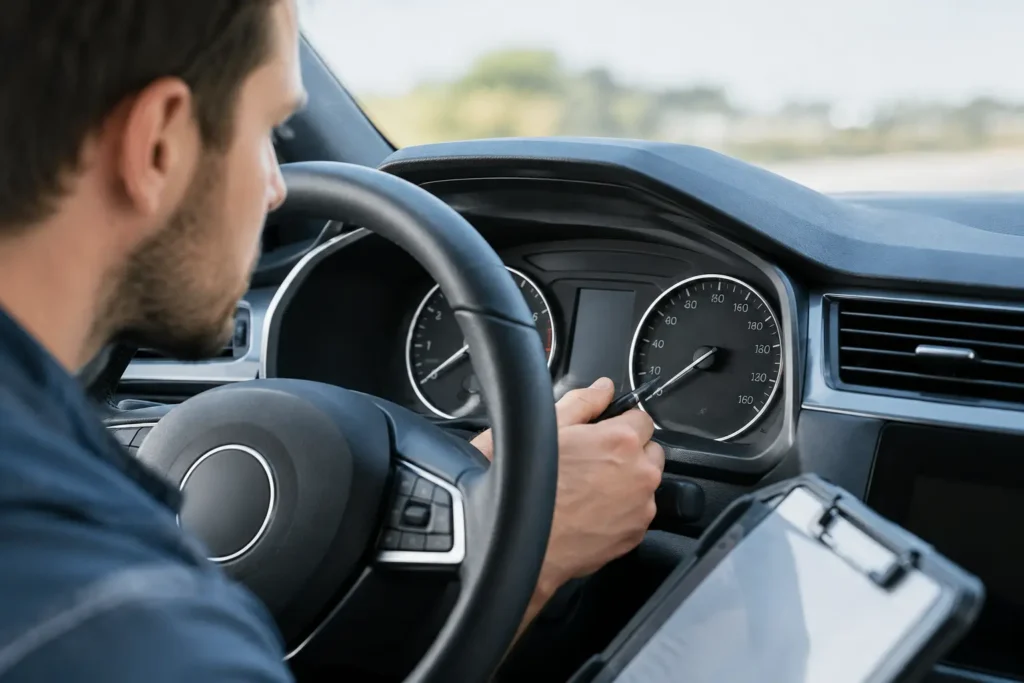
A used vehicle can look clean, drive well, and still carry a mileage story that does not add up. Odometer fraud is less obvious than it used to be because digital displays leave no worn number wheels behind. That is why buyers should verify vehicle odometer readings with more than a glance at the dashboard.
Mileage affects value, maintenance timing, warranty coverage, and the likely life left in major components. A mismatch does not automatically mean fraud. A cluster may have been replaced after a failure, or a record may contain a simple data-entry error. But any gap deserves an explanation you can document before money changes hands.
Verify Vehicle Odometer Readings Before You Negotiate
Start before the test drive. Ask the seller for the vehicle identification number, current odometer reading, and maintenance records. A private seller who has owned the vehicle for years should usually be able to provide at least some service invoices, inspection receipts, registration renewals, or oil-change paperwork.
Look for dates and mileage together. The individual number matters less than the pattern. A vehicle showing 72,000 miles today should not have a repair invoice from two years ago showing 88,000 miles. It also should not show only a few hundred miles of travel across several years unless the seller has a credible reason, such as seasonal use or long-term storage.
Be direct without treating every seller like a criminal. Say that you are comparing records as part of your normal used-car review. A straightforward answer, supported by paperwork, is very different from a vague explanation that changes when you ask follow-up questions.
Check the title and disclosure paperwork
Federal law generally requires a mileage disclosure when ownership transfers for many vehicles, though rules and exemptions can vary by vehicle age and transaction type. Review the odometer statement on the title or related transfer documents. Watch for language such as “not actual mileage,” “exempt,” or “odometer discrepancy.”
These labels are not always a deal breaker. An older vehicle may be legally mileage-exempt, and a replacement instrument cluster can create a legitimate discrepancy. Still, the label changes the risk profile. If you cannot establish a reasonable mileage history, price the vehicle accordingly or move on.
Also compare the VIN on the title to the VIN plate at the base of the windshield and the driver-side door label. A mileage check is only useful when you are certain every record belongs to the same vehicle.
Build a Mileage Timeline From Independent Records
The strongest approach is to create a simple timeline. Put the known date and mileage from each source in order: title transfers, state inspection records where available, dealer service records, independent shop invoices, tire purchases, emissions tests, and vehicle-history reports.
Vehicle-history reports can be useful because they combine data from many sources. They can show reported odometer readings from auctions, service facilities, inspections, and title events. They are not complete records, though. A clean report does not prove the mileage is accurate. It only means the report did not find a conflict in the data it received.
Service records often provide better context. A receipt for brake work, a battery replacement, or a set of tires may include the mileage recorded by the technician. Multiple routine invoices spread over several years are harder to dismiss than one isolated report.
Look for a generally upward trend. Small differences can happen when a shop enters an estimate, rounds a number, or records mileage after a short road test. Large backward jumps are the concern. A 500-mile variation may be explainable. A 25,000-mile drop requires clear proof of what happened.
Use inspection history when your state records it
Some states record odometer readings during safety inspections or emissions testing. If those records are available, they provide independent checkpoints that a seller cannot easily edit. They are especially valuable on vehicles that have changed hands several times.
Availability varies, and not every inspection station reports the same information. Treat state records as one source in a broader review, not the final answer.
Inspect the Vehicle for Mileage Clues
The cabin often tells a more honest story than the display. Mileage is not the same as wear – city driving, commercial use, pets, children, and poor care can age a low-mile vehicle quickly. Still, condition should make sense for the number on the odometer.
On a vehicle advertised with low mileage, inspect the driver’s seat bolster, steering wheel, pedals, gear selector, door handle, and ignition area. Deeply worn pedals, a shiny smooth steering wheel, or a collapsed seat cushion can be inconsistent with a claimed 30,000 miles. They may also simply indicate hard use, so do not rely on one clue alone.
Look under the hood and underneath the vehicle as well. Original hoses, belts, suspension parts, and brake components do not prove mileage, but they can support or challenge the overall story. New parts are not suspicious by themselves. Every vehicle needs maintenance. The question is whether the service history and physical condition agree.
Pay attention to the instrument cluster. Confirm that the display works properly and that no warning lights appear briefly and then go dark. On some vehicles, a replacement cluster may be noted on a service invoice or have a different appearance from the surrounding trim. Ask when it was replaced, why it was replaced, and how the mileage was set or documented.
Have a Mechanic Read the Vehicle’s Modules
A pre-purchase inspection is one of the best expenses a used-car buyer can make. A qualified technician can assess more than brakes and leaks. On many modern vehicles, a scan tool may retrieve mileage-related information from other control modules, such as the engine computer, transmission controller, body control module, or key data.
This is not a universal solution. Some vehicles store mileage in only one place, some modules report values that are not meant to be a formal odometer, and replacement parts can complicate the picture. But a technician who knows the make can spot inconsistencies that a general visual inspection will miss.
Ask the shop to document what it finds. If the dashboard shows 54,000 miles but another module suggests substantially more, pause the purchase until the seller can explain the difference. A seller who refuses an independent inspection is giving you useful information, too.
Take a Road Test, But Know Its Limits
A road test cannot verify historical mileage. It can tell you whether the speedometer and trip functions behave normally and whether the vehicle drives like its claimed condition. Note the odometer reading before and after a known route. The trip distance should increase logically, and the dash should not flicker or reset.
A GPS-based speedometer app can provide a separate speed and trip-distance reference during the drive. It is useful for checking whether the vehicle’s displayed speed is broadly reasonable, but it is not evidence of a vehicle’s lifetime mileage. GPS measures the route you travel now, not the miles removed from an odometer years ago.
Listen for suspension noise, transmission hesitation, brake pulsation, and excessive engine vibration. None of these symptoms proves mileage fraud. They do help you judge whether the vehicle’s mechanical condition matches the asking price and the seller’s claims.
What to Do When the Numbers Do Not Match
Do not rush to accuse the seller. Ask for documents that explain the inconsistency. A legitimate replacement cluster should come with a repair order, a statement of the mileage at replacement, or records showing the corrected reading. If an error appears in a vehicle-history report, the reporting business may be able to confirm or correct it, although that process can take time.
If the explanation is incomplete, treat the mileage as unknown. That usually means a lower value, more careful inspection, and a willingness to walk away. Buyers get into trouble when they accept a convenient answer because the vehicle is otherwise appealing.
The best used-car purchase is not the one with the cleanest dashboard. It is the one with a mileage story that holds up across paperwork, inspection, and common sense.